
An important, ongoing theme in my approach to product leadership is open innovation. The advantages of business ecosystems are well-established and strategic partnerships, following from pilot partnerships, offer efficient ways to explore product and business opportunity spaces. In this section, I showcase some particularly noteworthy examples.
CiteAb: The First Publishing Partner for Lab Reagents Data
Context: Based on my team’s successful deploy of an antibody data search, there was a clear opportunity to broaden activity in this space. Specifically, this meant compiling more reagent data and also looking at opportunities to expand our reach. Although the team had developed considerable technical expertise, partnering with a specialist firm to complement our efforts could be hugely beneficial. On a product level, providing more contextualized antibody usage data would bring greater value to researchers by supporting experimental reproducibility. On a commercial level, collaborating with specialists would open the door to new data monetization opportunities (see case study on ‘Data Monetization’).
Approach: As the life science reagents data market is quite niche, there weren’t many potential partners to explore. That said, I did initiate and oversee some pilot partnerships with specialist firms. Unfortunately, none of these projects were successful. The situation took a fortunate turn, however, when my team made contact with the life science data startup CiteAb.

CiteAb’s data products had reached good product-market fit. However, their data coverage could benefit from incorporating the life science data my team could provide. Such an arrangement would be mutually beneficial: CiteAb could fill data coverage gaps while my team would benefit from increased experience and exposure in the larger life science data space.
Aligning on a pilot project, we designed tests to validate foundational hypotheses. Gratifyingly, the pilot was successful and discussions then shifted to agreeing on commercial terms for a full-scale partnership. Terms were quickly agreed, though new workflows and templates to support a data monetization partnership of this sort were being developed simultaneously. In the end, a novel commercial structure was accepted, setting the stage for a full scale partnership.

Impact: The impact and influence of the partnership with CiteAb was multifaceted. To start, the partnership meant that Springer Nature was the first publisher to collaborate with CiteAb, a clear demonstration of open innovation aimed at supporting the research community.
For Springer Nature, the partnership was quite signficant. The terms agreed to with CiteAb were the first of their kind at Springer Nature, for example, a data sharing provision allowed for CiteAb-enriched data to be incorporated into the Springer Nature Experiments platform. This enhancement helped increase traffic, engagement, and platform user satisfaction scores. Business impacts were equally significant. The legal and commercial terms of the CiteAb partnership formed the basis of other future partnerships. Furthermore, the partnership represented a successful effort at establishing a completely new revenue stream in a previously unexplored market.
protocols.io: Partnering to Supporting Digital Transformation via Open Science
Context: Two slowly evolving yet extremely important developments in modern scientific research are open science and digital transformation. Open science aims to make science more transparent and inclusive by, among other things, making research and related data widely available and accessible. Digital transformation, in a scientific context, is a fundamental shift to fully digital (and often automated) lab infrastructures and operating models.
Gaining a deeper understanding of these two important shifts is a critical concern for my team because both open science and digital transformation are reinventing how science is done. However, these spaces were (are!) highly fragmented. A plethora of policies, products, platforms, standards, and adoption levels make product discovery a challenge. This challenge is especially poignant since my team’s product work on lab protocols is well-positioned to play an important role. We had a clear need to better understand the opportunity spaces and to use this understanding as a foundation for new product and business development.
Approach: The fragmentation of digital lab and open science spaces made pilot partnerships an especially attractive option. Thus, I connected with a potentially ideal partner: the startup protocols.io. They had built a cutting-edge digital platform for lab protocols and had established themselves as a fast-rising player in the open, digital research space. We quickly aligned on the scope for a pilot partnership. For the pilot, a content selection from my team’s products would be converted and made available on the protocols.io platform. The two product teams would then jointly study user behaviors and workflows to better understand open science behaviors and the uptake of digital lab tools. Depending on the outcome, there was a potential for a fast scale up as well.

Impact: Like many a good study, the pilot project produced more questions than answers. What was clear, however, was that the opportunity space, i.e. the intersection of open science and digital labs, was validated as a strategically important one. Another important outcome of the pilot was the firm foundation for collaboration with protocols.io and our mutually shared vision to support open science and digital transformation. This vision and the positive experience during the pilot partnership directly contributed to the most important outcome of the pilot partnership - Springer Nature’s acquisition of protocols.io. Personally, it was thrilling to see protocols.io go from external collaborators to colleagues in the same business unit. I’m very proud that my efforts played a part in this story and I’m especially excited to continue working with the protocols.io team on projects in the open science and lab digitization spaces.

AI Licensing/Data Monetization
Historically, scientific content was consumed in human readable forms like print and PDFs. Now, the shift to digital and machine readable formats along with the explosion in AI applications, has created new business models and product opportunities. Some of my experiences working in the AI licensing and data monetization space are explored below.
Building the Foundations for Growth: Creating a Center of Excellence
Problem: For decades, the scientific publishing has seen waves of transformation (aka “disruptions”). In the 1990s, there was the shift from print to digital platforms. The 2010s were the age of Big Data, and from 2022, the (generative) AI boom kicked off. These waves share one attribute: the need for scientific content to be delivered in new ways for new applications, i.e., a shift from human readable content to machine readable and executable content. This shift also necessitates new business models to reflect the new value propositions.
In this context, Springer Nature’s Data and Analytics Solutions team was organically growing a pipeline of business and product opportunities beyond what our historic products could offer. There was increasing demand for things like customized data sets for text and data mining (TDM) and APIs, with growing customer needs to integrate scientific data directly into R&D workflows. While promising, the heterogeneous nature of the products, markets, use cases, and compliance issues hampered both product and business development. The haphazard, siloed approach of various Product Teams (including mine!) clearly wasn’t scalable.
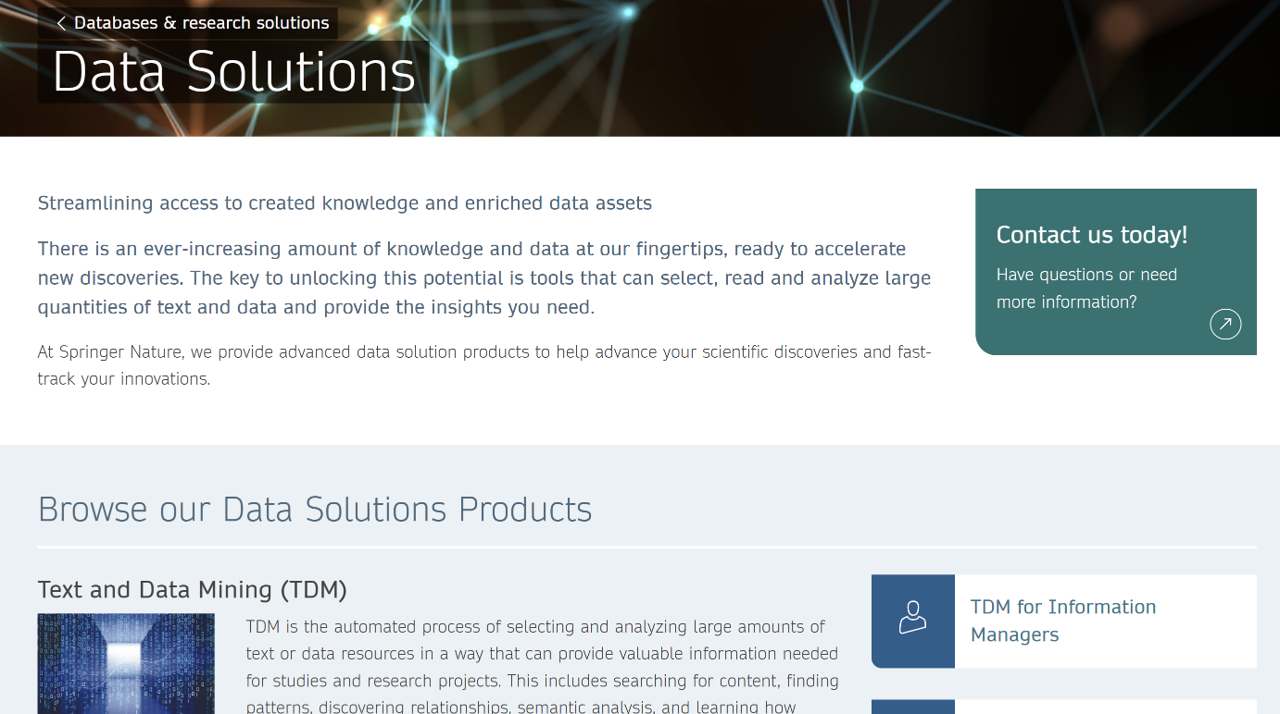
Solution: Working closely with the department head, I was charged with creating and developing a ‘Data Monetization Center of Excellence.’ My task, in parallel to my full time product leadership position, was to consolidate efforts across Product Teams and establish a scalable foundation. Aligning and working with many stakeholders, I developed an opportunity pipeline tracker, cataloged our data assets, classified use cases by risk and business value, established standardized workflows with support areas like Legal and Finance, and developed new business models proposals. It was a tremendous amount of work, but in a good way!
Impact: Originally, I was leading the Center of Excellence as a ‘side project’ since my own team was actively exploring the space. However, after establishing the foundations mentioned above, it was clear that the Center of Excellence demanded the full attention of a separate, dedicated Product Team. Thus, Springer Nature’s Data Solutions Team was born. Although my time formally leading the data monetization space would end, my own team’s activity in the area continued (see the below).
A New Business Model for a New Digital Lab Use Case
As the following project was never formally publicized, I can neither refer to any public records nor can I disclose specific details about the company.
Problem: While leading the Data Monetization Center of Excellence (see above), a intriguing opportunity presented itself. I was approached by a digital lab startup with a novel value proposition: they were building a voice lab assistant and wanted to partner with my team. Specifically, they wanted to train their machine learning system to improve its voice recognition capabilities (i.e., reduce word error rate). The lab protocols data my team oversees would be a ideal for this use case. After negotiations, we agreed to terms for a pilot project. There was, however, a major blocker. Data licensing for this kind of use case had no precedent. Thus, there were no readily available contracts, workflows, business models, or pricing to use. All of these things would need to be created from scratch.
Solution: Working closely with Legal, Sales, and my team’s product managers and data scientists, I created appropriate structure for the pilot project. My team would create an ML training set based on relevant subject areas. This curated data set would then be used to train a model in a ring-fenced test environment. Improvements to the ML algorithm would then be measured. Depending on the improvement level, different pricing tiers would be in effect - the tiers themselves were agreed upon by all parties. Furthermore, if the success criteria were met, then there would be a clear path to scaling up, from pilot into a full partnership.

The pilot project structure worked well for many reasons. First, since only a small fraction of data was used in the pilot in a ring-fenced environment with very specific reuse terms, the risk associated with data sharing was effectively mitigated. Furthermore, in case of a successful pilot, a scalable commercial agreement could be quickly and easily implemented.
Impact: On a product level, the pilot failed! The improvements to the ML algorithms weren’t as high as expected and the scale-up thresholds were not met. Commercially, however, the pilot was successful. Aside from a successful data licensing deal for the pilot, we also established a noteworthy industry presence.
The impact of the pilot project was wide-ranging. First, this pilot was the first true data licensing deal for a digital lab use case at the company. As such, it was an important proof-of-concept to the wider organization for novel product and commercial opportunities. The project itself was a finalist in the company’s inaugural Innovation Tournament and was well-regarded by executive leadership.
Additionally, this pilot also illustrated a principle that I’ve long been a firm believer in: Open Innovation. When two organizations come together in innovative ways, the result can be a true synergy of value that neither organization alone could deliver. As one of the pioneers of Open Innovation projects at my company, I’ve repeatedly demonstrated the value such partnerships can deliver. Some of these cases are detailed in the ‘Strategic Partnerships’ section.